




 Shop
Shop 


Houses Tell Stories. Words Travel.
What connects a small house in a Slovenian village with an Irish medieval
tower? A Slovenian poet with an Irish poet? And how can words written a
century or two ago still tell us something about who we are today?
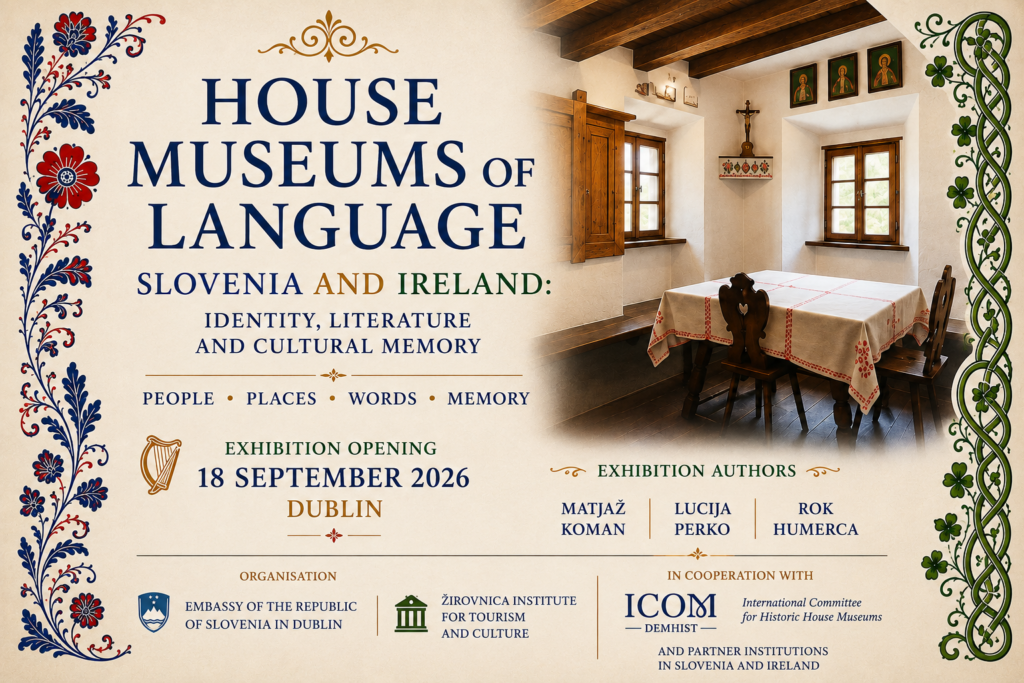
House Museums of Language: Slovenia and Ireland – Identity, Literature
and Cultural Memory is an exhibition created by the Žirovnica Institute
for Tourism and Culture in cooperation with the Embassy of the Republic
of Slovenia in Dublin.
The exhibition brings Slovenia and Ireland into dialogue through language,
literature and places of memory. Despite their different historical experiences,
language and the written word played an important role in shaping cultural
and national identity in both countries.
Birth houses, chosen homes, museums and interpretation centres reveal how
closely people, places, words and memory are connected.
Different histories. Shared questions. New connections.
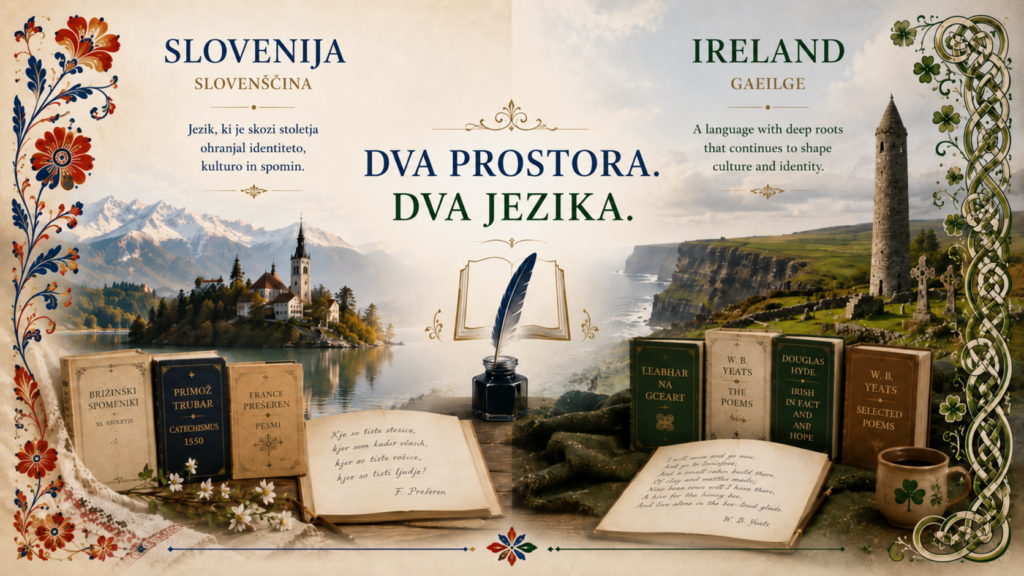
Slovenia · Slovenian
From the Freising Manuscripts and the first books printed in Slovenian
during the Reformation to the language of an independent state,
Slovenian has remained closely connected with literature, culture
and identity.
Ireland · Irish
Irish has one of the longest written traditions in Europe. After centuries
of losing ground as a language of everyday public life, it became an
important part of the cultural revival at the end of the 19th century.
Today, Irish and English meet within an exceptionally rich literary culture.
Different histories. Different languages. A shared belief in the power of words.
When Stories Meet
Slovenian and Irish stories are not the same. Yet when we place them
side by side, unexpected connections begin to appear: language,
literature, landscape, home, identity and memory.
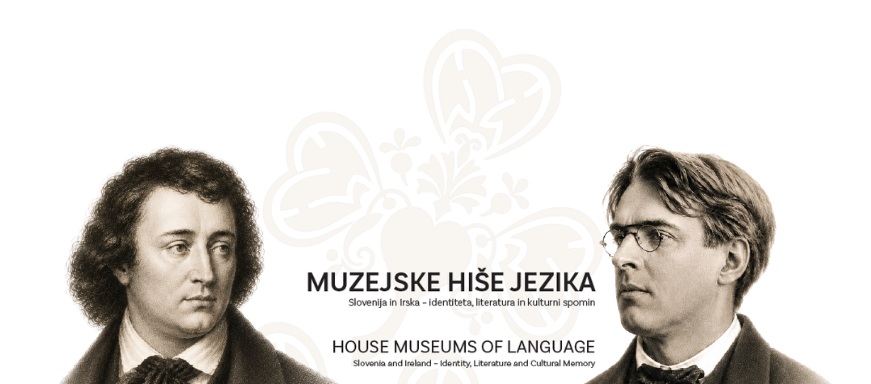
Matija Čop ↔ Douglas Hyde
Language and Revival
Čop expanded the expressive and literary possibilities of Slovenian,
while Hyde worked to preserve and restore the public role of Irish.
Their stories reveal two different paths through which language
can become an important part of cultural and national identity.

France Prešeren ↔ W. B. Yeats
Poetry and Nation
Both poets became central figures of cultural memory. Their poetry is
deeply connected with language and with the places from which they came,
yet through literature, memory and translation it travelled far beyond
those places.

Ivan Cankar ↔ Oscar Wilde
Artist and Society
Cankar and Wilde were perceptive observers of society. Literature allowed
them to explore morality, social expectations and the relationship between
the individual, the artist and society.

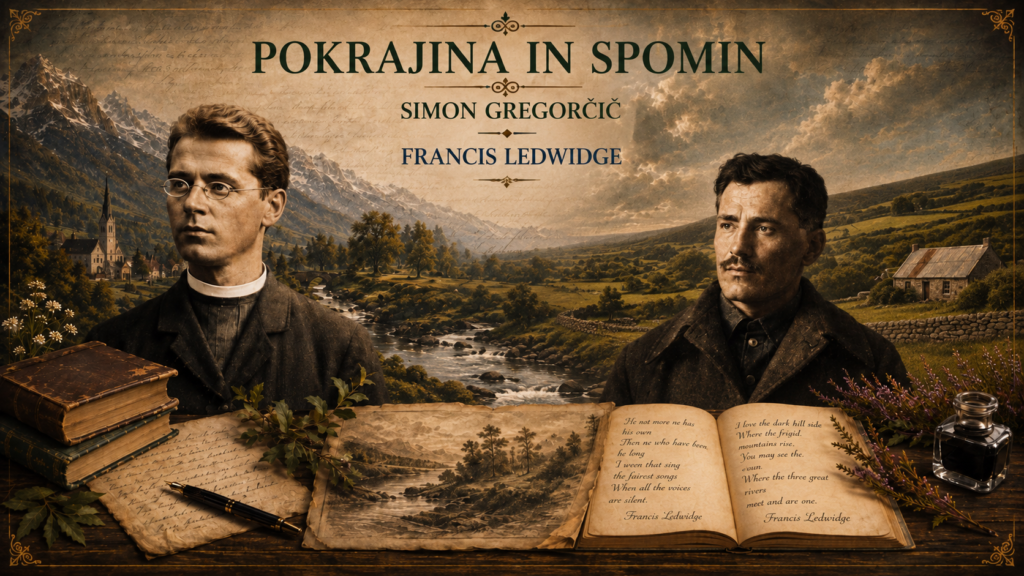
Simon Gregorčič ↔ Francis Ledwidge
Landscape and Memory
The Soča Valley and the landscape of the
Boyne Valley are far more than settings.
In their poetry, landscape becomes a carrier
of memory, belonging, history and loss.
Alma M. Karlin ↔ James Joyce
A World Beyond Borders
Karlin travelled around the world, while Joyce left Ireland but kept Dublin
at the centre of his literary universe. Both show that distance does not
necessarily break our connection with home – it can also transform it.

House Museums and Places of Memory
Not every place in this exhibition is a birth house, and not every historic
building has survived unchanged. Some preserve original interiors and
objects; others have been reconstructed, adapted or given new roles.
And sometimes the person we remember never even lived there.
What connects these places is not architectural authenticity alone, but the
relationship between people, place and memory. Together, they show how
differently cultural memory can inhabit a house.
A house does not preserve only walls. It preserves stories.

Prešeren’s Birth House
Vrba, Slovenia
France Prešeren’s birth house became Slovenia’s first house museum
dedicated to a notable individual in 1939. Today it is at once a historic
place, a museum object and one of the central sites of Slovenian cultural memory.

Thoor Ballylee
County Galway, Ireland
The medieval tower was purchased by W. B. Yeats in 1917 and transformed
into a family home. The tower, the river and the surrounding landscape
became part of his creative world.

Čop’s Birth House
Žirovnica, Slovenia
The reconstructed birth house now connects the story of Matija Čop,
the archaeological heritage of Ajdna, the Žirovnica Cultural Heritage Trail
and the life of the local community.

Douglas Hyde Interpretative Centre
County Roscommon, Ireland
The former church, closely connected with Hyde’s family and childhood,
is today a place of memory dedicated to his life and his role in the
revival of the Irish language and culture.

Cankar Memorial House
Vrhnika, Slovenia
The memorial house evokes the modest environment from which one of
Slovenia’s most important writers and playwrights emerged.

Oscar Wilde House
Dublin, Ireland
Oscar Wilde spent most of his childhood and youth in the Georgian
townhouse on Merrion Square. The Wilde family home was an important
setting for Dublin’s cultural and intellectual life.

Alma M. Karlin Memorial House
Pečovnik near Celje, Slovenia
This modest house is where writer, world traveller and polyglot
Alma M. Karlin spent the final years of her remarkable life.

James Joyce Centre
Dublin, Ireland
Joyce never lived in this house, yet the historic building connects the
real Dublin with his literary city. Among its most remarkable objects is
the original entrance and door from 7 Eccles Street.

Simon Gregorčič’s Birth House
Vrsno, Slovenia
The house museum beneath Mount Krn connects Gregorčič’s memory with
the landscape and way of life that strongly shaped his poetry.

Francis Ledwidge Museum
Slane, County Meath, Ireland
The poet’s modest birth house preserves the memory of his poetry
and his deep connection with the Irish countryside and the landscape
of the Boyne Valley.
When Only the Memory of Home Remains
The story of Berta Zois and William Charles Heaton-Armstrong reveals
an unexpected connection between Slovenia and Ireland. Berta was born
in 1859 at the Javornik estate in Gorenjska and married William,
a descendant of a Scots-Irish family, at Bled in 1885.
Their family history connects three places with very different destinies:
Javornik disappeared in its former form, Farney Castle survived as a
historic building, while Mount Heaton found a new life as part of
Mount St Joseph Abbey.
Stories live for as long as we continue to tell them.
Poems Across Languages
A special part of the exhibition is devoted to translations of poetry
by France Prešeren and W. B. Yeats. Prešeren’s poem Kam? (Where to?)
is presented in Slovenian, English and Irish, while Yeats’s
The Lake Isle of Innisfree appears in English, Slovenian and Irish.
Read side by side, they show how translation carries a poem into a new
linguistic and cultural space.
Translations:
Mirjam Dular · Séamus Mac Conmidhe · Sven Pádraig Ó Siochfhradha Prešern
Objects in the Exhibition
The exhibition also includes objects from everyday life in Slovenian homes
of the 19th and early 20th centuries. Most did not belong to the figures
presented in the exhibition, but help evoke the material world of the time
and places in which they lived.
The objects form part of the museum collection of the
Žirovnica Institute for Tourism and Culture.
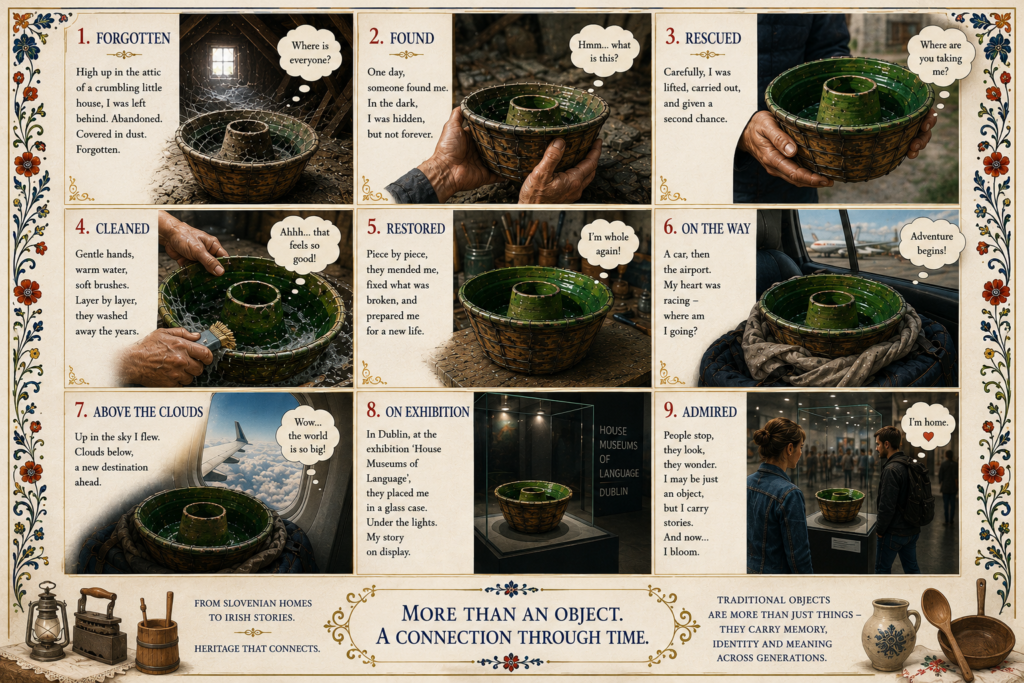
The Story of an Object: A Potičnica
Among the objects travelling from Slovenia to Dublin is a potičnica –
a traditional baking mould used for making potica, one of Slovenia’s
best-known festive cakes.
Once forgotten in an attic, it was found, rescued, cleaned and restored.
From an everyday household object, it became part of a museum collection –
and now its journey continues to an exhibition in Dublin.
Its story shows how an ordinary object can become a carrier of memory,
connecting everyday life, cultural heritage and people across generations.
A small object. A meaningful story.
Three Creators. Three Perspectives on Heritage.
The exhibition was created by three doctoral researchers in heritage
studies at the Faculty of Arts, University of Ljubljana. They come from
different professional backgrounds, but share the same passion –
cultural heritage.
Matjaž Koman is Director of the Žirovnica Institute for Tourism and Culture,
a doctoral researcher in heritage studies and a trained actor. His work focuses
on house museums, museum interpretation, sustainable tourism and the role of
cultural heritage in contemporary communities. He is also the creator of
House Museum Nerd, a personal project exploring house museums around the world.
Lucija Perko is an architect, designer and doctoral researcher in heritage
studies. Her work connects cultural heritage, design, traditional knowledge
and craftsmanship, drawing on her international experience and collaboration
with local communities in preserving and reinterpreting traditional skills.
Rok Humerca is an archaeologist specialising in landscape and underwater
archaeology. His research focuses on cultural heritage and local history,
including archaeological research at Javornik and the underwater heritage
of Lake Bled. His work explores the connections between archaeology, cultural
landscapes, memory and local communities.
THE EXHIBITION IN DUBLIN
When the Stories Met in Dublin
House Museums of Language – Slovenia and Ireland: Identity, Literature and Cultural Memory
opened on 18 September 2026 at the Embassy of the Republic of Slovenia in Dublin
as part of Culture Night 2026.
The opening brought together house museums, literature, poetry and music from
Slovenia and Ireland. Around 300 visitors explored the exhibition during the
opening evening.
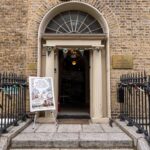
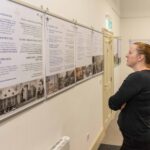
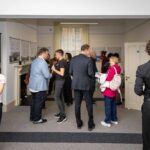
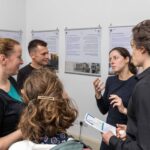
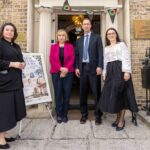

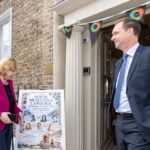
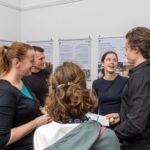
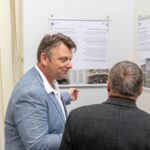
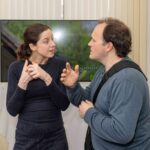
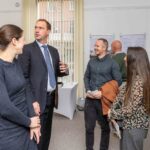
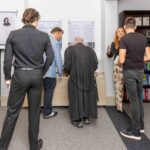
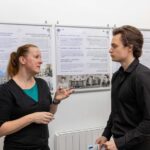
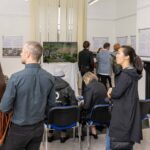
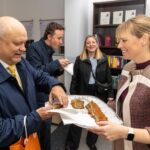
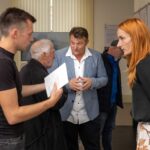
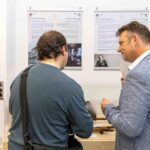
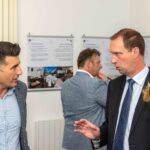
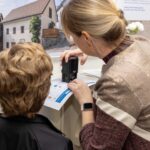
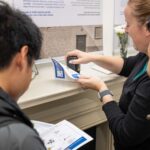
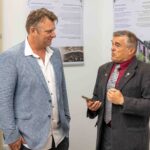
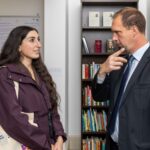
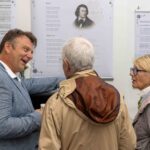
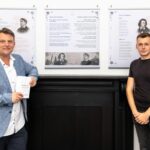
Photo: Viktor Cibulka
A Greeting from the House Museum Community
At the opening, Timna Seligman, Chair of ICOM DEMHIST,
welcomed visitors in a special video message and reflected on the role of
house museums, cultural memory and international collaboration.
A Song Returns to Ireland
We ended the opening with music. Aleksander Mežek recorded
a special performance for the exhibition – a musical connection between
Slovenia and Ireland.
Houses have stories. Words travel. And sometimes, songs travel too.
The Stories Continue
The exhibition is only part of the story. The accompanying booklet brings
together the people, house museums, places of memory, poems and objects
presented in Dublin.
It offers more stories, more connections and another way to explore the
dialogue between Slovenia and Ireland.
Take the stories with you.
CREDITS
Avtorji razstave / Exhibition authors Matjaž Koman · Lucija Perko ·
Rok Humerca
Texts Matjaž Koman · Lucija Perko · Rok Humerca
Exhibition design and press preparation Lucija Perko ·
Exhibition publication layout Liza Perko ·
Poetry translations Mirjam Dular · Séamus Mac Conmidhe · Sven Pádraig Ó Siochfhradha Prešern
Objects Museum collection of the Žirovnica Institute for Tourism and Culture
Restoration and selection of objects for the exhibition Anja Bunderla
Photographs and visual material
Čopova rojstna hiša / Čop Birth House: Aleš Košir, 2025 ·
Douglas Hyde Interpretative Centre: Lee Williamson / Shuttermaniac™ ·
Prešernova rojstna hiša / Prešeren Birth House: Aleš Košir, 2026 ·
Thoor Ballylee: Jerzy Strzelecki / Wikimedia Commons, CC BY-SA 3.0 ·
Cankarjeva spominska hiša / Cankar Memorial House: arhiv / archive Visit Vrhnika ·
Oscar Wilde House: arhiv / archive Oscar Wilde House ·
Francis Ledwidge Museum: arhiv / archive Francis Ledwidge Museum Committee ·
Rojstna hiša Simona Gregorčiča / Simon Gregorčič’s Birth House:
Damjana Fortunat Černilogar, Marko Grego; hrani / collection Tolminski muzej / Tolmin Museum ·
Spominska hiša Alme M. Karlin / Alma M. Karlin Memorial House: Robi Valenti, 2024 ·
James Joyce Centre: arhiv / archive James Joyce Centre ·
Mount St Joseph Abbey, Roscrea: Jonathan Thacker / Geograph, CC BY-SA 2.0 ·
Mount Heaton, c. 1890: National Library of Ireland ·
Javornik: F. pl. Kurz W. Thurn u. Goldenstein /
Narodni muzej Slovenije, inv. št. R-482 / Tomaž Lauko
Exhibition video
There’s No Fairer Place · Čop Birth House
Organisation and production
Embassy of the Republic of Slovenia in Dublin · Žirovnica Institute for Tourism and Culture
With the support and collaboration of
Culture Night 2026 · EUNIC Ireland
The exhibition was first presented during Culture Night 2026 at the Embassy of the Republic of Slovenia in Dublin,
with the support of the Cultural Fund, jointly administered by the Ministry of Culture and the Ministry of Foreign and
European Affairs of the Republic of Slovenia. We hope that its journey will continue, creating new encounters between
Slovenia and Ireland, and new connections between cultures, stories and places of memory.
Acknowledgements
ICOM DEMHIST · James Joyce Centre · Oscar Wilde House ·
Francis Ledwidge Museum Committee · Slane Community Forum – The Hub ·
Roscommon County Council · Zavod Ivana Cankarja / Visit Vrhnika ·
Tolminski muzej · Zavod za kulturne prireditve in turizem Celeia Celje ·
Narodni muzej Slovenije · Comhar · Cecilia Casas Desantes · Timna Seligman · Aleksander Mežek ·
Anna Fox · Viktor Cibulka
Dublin · 2026